Independent · specs from the makers
Fishing Kayak Comparison: Specs, Types and Prices
A fishing kayak is a stable, usually sit-on-top kayak built around rod holders, gear tracks and open deck space. Choose one by how you will move it (paddle, pedal or motor), how much weight it must carry, and whether you can lift it onto your vehicle alone.
By the editorial team · Updated 2026-11-25 · Specs from the makers, checked Nov 2026
Compare fishing kayaks
The table below lists every model we track with its manufacturer specs and list price. Filter by type, propulsion and price, or sort by hull weight and capacity to shorten the list in a few clicks.
Specs and list prices from each manufacturer's product page (checked Nov 2026); 53 kayaks. We compare published specs; we have not tested these kayaks on the water. Prices change — check the maker's site.
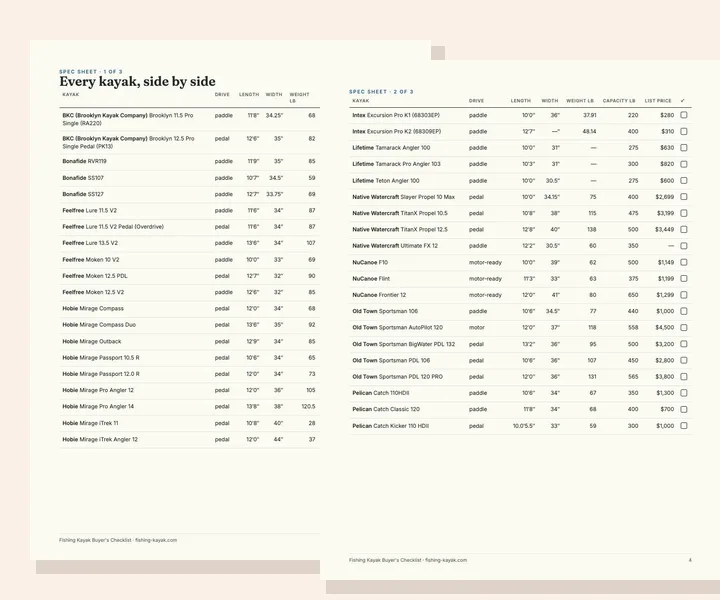
Shopping in person? The free buyer's checklist has a printable spec sheet of every kayak here.
Shopping for a fishing kayak usually starts with a dozen browser tabs and spec sheets that never use the same units. This site puts 54 current models in one place: length, width, hull weight, maximum capacity, rod holders and list price, each copied from the manufacturer's own product page.
We compare published specs. We did not paddle these boats or run our own water tests, so nothing here is a hands-on rating. What you get instead is a consistent way to line models up and spot the trade-offs before you visit a dealer or a demo day.
What makes a fishing kayak different from a regular kayak
A recreational kayak is built to move you. A fishing kayak is built to hold you still and keep your hands free: a wider hull, flush-mount or swivel rod holders, accessory tracks for a fish finder or rod holder mounts, a raised seat and a tankwell behind you for a crate or cooler.
Most models in our table are sit-on-tops because an open deck is easier to rig and to stand on. Sit-on-tops can also be righted and climbed back onto from the water 1, which matters when you fish alone. A few anglers still prefer a sit-inside for cold water or long paddles.
The four types you will run into
Of the 53 models we track, 48 are sit-on-tops, 5 are inflatables and 1 is a sit-inside hybrid. By propulsion, 27 are paddle boats, 21 have a pedal drive, 5 are paddle hulls with a motor mount and 1 comes with an integrated trolling motor.
| Type | What it suits | Where to read more |
|---|---|---|
| Paddle sit-on-top | Lowest price, shallow water, simple to own | budget picks |
| Pedal sit-on-top | Hands-free boat control on big water | pedal picks |
| Inflatable | Apartments, small cars, fly-in trips | inflatable guide |
| Sit-inside | Cooler water, paddling efficiency | sit-on-top vs sit-inside |
If you are torn between legs and arms, the pedal vs paddle comparison goes through cost, weight and shallow-water limits in detail.
Four numbers that narrow the list fast
Capacity. The maximum capacity on a spec sheet has to cover you, your gear, the paddle and anything else aboard 2. Brooklyn Kayak Company suggests staying below 70% of that maximum for good handling 2; other makers use different margins, which our weight capacity page compares side by side.
Width. Sit-on-tops get their stability mainly from width 1. In our table widths run from about 30 to 44 inches, and the wider boats are the ones makers describe as stand-up platforms.
Hull weight. This decides whether you can load the boat by yourself. Makers report it differently: some give the bare hull, some the assembled boat with seat and drive. We record which one each maker used, so a 65 lb figure and a 107 lb figure are not always comparable.
Length. Longer hulls track straighter and carry more; shorter ones turn faster and fit in a pickup bed. Most fishing models sit between 10 and 13 feet. The step-by-step buying guide walks through how to weigh these against your water.
Free printable · US Letter and A4
Get the Fishing Kayak Buyer's Checklist
Want all 53 models on two printable pages with a capacity worksheet and pre-launch checklist? Get the free Fishing Kayak Buyer's Checklist.
- Spec sheet of every kayak we track, to take to the store
- Capacity worksheet: you + gear → the kayak size you need
- Gear and safety checklist with the federal PFD rules
- Test-paddle questions and a pre-launch checklist
What fishing kayaks cost in 2026
We sort list prices into three tiers. These are regular prices shown on manufacturer sites in November 2026; many makers were also showing temporary sale prices, which we ignore.
| Tier | List price | Models in our table |
|---|---|---|
| Budget | under $1,000 | 19 |
| Mid | $1,000 to $2,499 | 19 |
| Premium | $2,500 and up | 14 |
| No clear price | conflicting or not listed | 2 |
The cheapest boat in the data is an inflatable, the Intex Excursion Pro K1 at $279.99; the most expensive is the Hobie Mirage Pro Angler 14 at $4,999. Across the 52 models with a clear price, the median works out to roughly $1,300 (our arithmetic). Pedal drives are the main reason a boat lands in the premium tier.
Match the boat to the water you fish
Ponds, small lakes and creeks. Short, light hulls are easier to launch from a bank and carry down a trail. A 10 ft paddle sit-on-top such as the Vibe Yellowfin 100, with a 51 lb hull, is typical of this group.
Big lakes and bays. Wind and distance favor longer hulls and pedal drives that let you hold a spot with your legs. Capacity also matters more, because you carry more gear for a longer day.
Rivers. Moving water rewards a hull that turns quickly and shrugs off rocks. Bonafide builds the RVR119 specifically for rivers, with a skeg system and a removable pod.
Coastal water. Salt water adds tides, boat traffic and federal rules on night-use visual distress signals for small boats on coastal waters, including the Great Lakes 3. Plan to rinse everything after each trip.
Safety rules that apply on day one
Federal rules require at least one wearable USCG-approved life jacket for each person aboard a recreational vessel, and kayaks are included 4. Many states add their own wear rules, so check your state before you launch. Our kayak fishing safety page covers lights, sound devices and cold water.
The Coast Guard's yearly accident report shows why the life jacket matters: most people who die in recreational boating incidents drown, and most of them were not wearing one 5. Whether your kayak needs a registration or a launch permit depends on the state and on whether it has a motor; see do you need to register a kayak.
How to use this site
Kayak fishing keeps growing. In 2025, 7% of US anglers fished from a kayak, up from 5% in 2015 6. That growth means more models, more variants and more confusing names.
Start with the table above, then go to the page that matches your question: best fishing kayaks by category, accessories worth adding, or the capacity and buying guides linked earlier. Every spec we quote is a manufacturer spec, and every price is a list price on the maker's site, checked Nov 2026.
Frequently asked questions
How much does a fishing kayak weigh?
Published weights in our table run from 51 lb for the lightest hardshell, the Vibe Yellowfin 100, to 138 lb for the Native TitanX Propel 12.5 fitted hull. Inflatables are lighter, from 28 lb for the Hobie Mirage iTrek 11 hull. Because one maker's 70 lb boat may include a seat and another's may not, read how each figure was measured before judging what you can lift.
Can you put a motor on a fishing kayak?
Many fishing kayaks accept one. In our table, 5 paddle hulls have a motor mount and 1, the Old Town Sportsman AutoPilot 120, comes with an integrated trolling motor. Several pedal models also take a bow or stern motor. Adding a motor changes the legal picture: the US Coast Guard counts any kayak with a motor as an open motorboat 5, so expect registration rules to apply.
Is kayak fishing getting more popular?
Yes, by the industry's own survey. The American Sportsfishing Association's 2026 report found that 16% of US anglers also went kayaking in 2025, up from 11% in 2015, and that the share fishing from a kayak rose from 5% to 7% over the same decade 6. More buyers have brought more models and more variants, which is why a side-by-side table helps.
What are the 3 golden rules of kayaking?
There is no official set of three rules; the phrase is used loosely online. A practical three that official sources back: keep a USCG-approved life jacket on, choose clothing for how cold the water is, and leave a float plan with a friend. US federal law requires a wearable life jacket for every person aboard, and many states add stricter wear rules 4.
Sources
- Aqua-Bound (paddle manufacturer), 2021: How to Choose: Sit-on-Top vs. Sit-In Kayaks
- Brooklyn Kayak Company (manufacturer), 2023: Clarifying Kayak Weight Capacity
- U.S. Code of Federal Regulations (via Cornell LII), 2026: 33 CFR 175.110 Visual distress signals required
- U.S. Code of Federal Regulations (via Cornell LII), 2026: 33 CFR 175.15 Personal flotation devices required
- U.S. Coast Guard, Office of Auxiliary and Boating Safety, 2025: Recreational Boating Statistics 2024
- American Sportfishing Association & The Outdoor Foundation, 2026: 2026 Special Report on Fishing (2025 data)